Perplexity - Individual AI Research into Collaborative
Abstract:
Converting normal chat, where a single person can only chat, into a group conversation
where the complete team can join and have a common place to open discussion with the perplexity
AI and use it to its maximum capacity.
This Case study talks about the development and implementation of the idea, a feature design to
transform how teams use AI tools.
Problem Statement:
The AI chatbot market faces a big problem of a collaboration gap, when most people are now comfortable and have adopted the AI chatbot, and now it's like a part of their life. Chatbots like Perplexity, Chat GPT, Gemini, or Claude just give the option to chat to an AI bot as an individual, and many times, this forces the team to work individually.
Current Situation:
AI chatbot like Perplexity, ChatGPT, Gemini and Cluade have become essential
tools for our day-to-day use and involved in our research, writing or problem solving. However, these
platforms are designed for individual use. Each user interacts independently, a private conversation
without automatic share access for teammates.
This creates a collaboration gap in the team context:
- • Team waste valuable time duplicating research or past conclusion.
- • No unified single place to preserve context, project history or team decisions.
- • Information gathered stays in the individual accounts, forcing manual reconsolidation.
This result in inefficient experience where AI benefits are limited to individual rather than enhancing the team collective intelligence.
Proposed Solution:
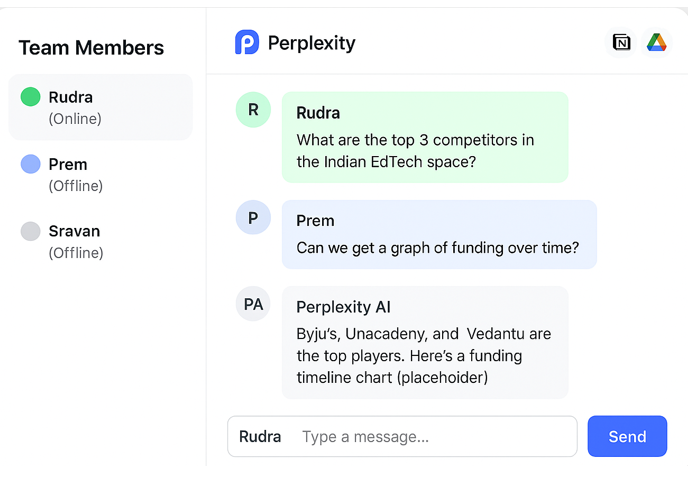
I redesign the Perplexity platform to offer live multi-user chat
sessions with Perplexity AI, maintaining a common place for shared context.
Key Point:
- 1. Real-time multi-user interaction: Two or more people from the same team can collaborate to use the perplexity AI chat option.
- 2. Team Memory: AI keeps track of all the past conversations as well as each person’s specific roles.
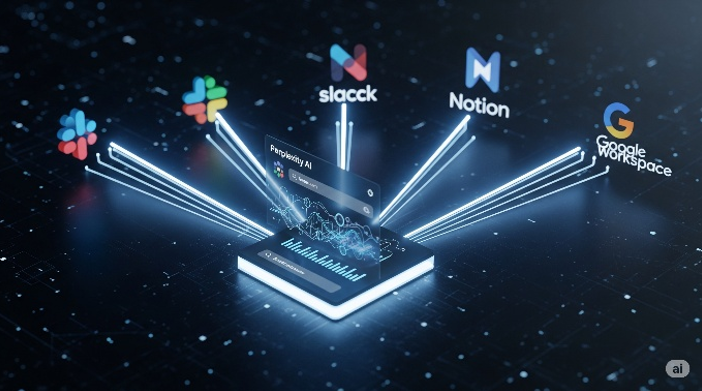
- 3. Third-party tool handling: Add team collaboration tools like Notion, Google Workspace, Slack, and similar types of team collab platforms
- 4. Absent team coverage: AI fills the gap if any of the team members is not available at that particular moment.
- 5. Avoid Duplication: This can help to avoid repeated duplicated research.
Primary Users:
- Research team in academic and corporate (40% of target)
- Managers conducting market research (25% of target)
- Strategic planning team in a large organization (15%)
- Consultants analyze problems (20% of the target)
User Research Findings:
- 40% faster project completion rate when used with AI together
- 16% throughput increase when AI is used together
- AI + human can reduce processing tim
Competition:
- Chat GPT: Strong but zero collaborative features
- Claude: Advanced reasoning, but limited real-time collaborative
- Gemini: No team research tool
- Current Perplexity: Good search and citation, but individual-focused
Why This Matters for Teams:
In today’s fast paced work environment, team needs strong
coordination, a shared understanding and seamless real-time collaboration. This small redesign shift
to a team centric AI system, which makes AI a genuine collaborator rather than an individual
assistant.
This shift is important for several reasons:
• Centralized Knowledge and Shared Context: Instead of multiple private chats, the AI platform
acts as a centralized knowledge hub accessible by all the teammates.
• Decision Making: With a single AI chat its becomes very easy to gather all the past
conversation through which teams can make a decision more reliably, reduce the risk of
miscommunication.
• Seamless Continuit: The Perplexity AI chat maintains context and history. This ensure that
discussions and decisions remains coherent, on matter who is present or absent.
In essence, Perplexity AI becomes not a personal tool but a shared partner who helps team to
think, decide and act together.
Goals & Success Metrics
Primary Objectives:
A AI-Powered collaborative platform in the market that gives team collab, features which can increase user retention, and also increase premium conversion rates through which new revenue options get opened, while adding a new plan, which is a TEAM-based pricing model.
Business Impact Goals (assuming 200,000 active pro users):
- Additional Monthly Revenue
- $10,00,000 ($20 -> $25)
- Annual Revenue Potential: $1,20,00,000 - Only
if we change the price of the pro version can we go for a completely new pack for the
team, too.
AI Feasibility & Technical Approach
Core Technical Component:
1. Live search session with multiple users
2. Manage multiple modes while interacting with the team and prevent conflicts.
3. AI understands project history, each member’s expertise, and team bonding.
Architecture:
The System adopts a hybrid approach combining AI workflow for structured tasks and agent-based systems for dynamic collaboration. The model context protocol ensures consistent communication between AI components while maintaining shared context across interactions.

Launch Approach:
Phase 1: MVP Launch (Month 1-4)
- Target Audience: Researchers and Consulting roles
- Features: Real-time sharing, commenting
- Success Criteria: 500+ active teams, 70% user satisfaction
Phase 2: Enhanced Collaboration (Month 5-8)
-Target Audience: Expand to Institutions and enterprise teams
-Features: contextual AI agents, Slack/Notion integration
-Success Criteria: 2,000+ active teams, 60%+ 30 days retention
Go to market strategy:
- The Freemium Model allows the team to experience collaborative benefits.
- Integration partnership with a productivity platform and a research institution.
- User community and research collaborative b
Pricing:
- Individual plan + (team idea): $25/ month (25% more)
- Team plans: $40-100/month based on team size
- Custom for the compa
Results and Impact:
- Monthly revenue increase
- Average session duration increase (200%)
- User satisfaction increases
- Resource savings (not many people from the same team searching for the same question)
Challenges
Managing Team Memory:
The AI must develop a thorough record of all team interactions, which is significantly more intricate than keeping track of individual chat histories. It also have to understand roles within the team, keep track of who contributed which ideas or data, what decision were reached and the reasoning behind it.

Integrating with Third-Party Tools:
The platform must also include the tools like Notion, Google Workspace, Slack and others. For example, when a AI generated decisions are made, it should update relevant documents or communication channels in real time. This integration ensures that Perplexity AI becomes part of daily workflows and not just a normal isolated discussion.
Supporting Absent Team Members:
It should track who is available and who is absent and adjusting the responses accordingly. Also capable of briefing the members returning after absence with detailed context and not just summaries.

Preventing Duplication:
The AI should identify if any research topic or queries are repeated and alerting the team to prevent duplicate efforts. This focus ensures discussions without wasting time for the same topics/ query.

Managing Multi-User Interaction Conflicts:
Managing multiple inputs demands sophisticated sessions management. The system must manage conversation turns, address conflicting queries and maintain integrity of shared conversational context.

Lifecycle:
1. Development: Model design while keeping the chat functions in mind
2. Validation: Testing across multiple teams to measure effectiveness, adaptability
3. Deployment: Gradual rollout to selected users and monitoring performance
4. Monitor: Check the performance of the model and adoption metrics
5. Maintain: Regular updates and retention based on usage patterns
6. Evolution: Model improvement driven by user feedback.
Conclusion:
The idea presents the opportunity when no major AI player has explored it till now.
However, the complexity of making it high, the uncertainty of adoption, and the pricing strategy
leave many questions:
1. Is the market ready for team-based AI collaboration, or is it too early?
2. How will it affect the individual chats with the AI?
3. Would the potential profit justify the development cost?
Perplexity has to take the difficult decision of whether they should add the feature of team-based AI
collaboration and risk the unknown, or continue refining its stronghold in Individual AI research and
wait for clearer market signals?
References:
• Human-AI Collaboration: Trade-offs Between Performance and Preferences (arXiv, 2025).
(https://arxiv.org/html/2503.00248v1)
• Evaluating Human-AI Collaboration: A Review and Methodological Perspectives (arXiv).
(https://arxiv.org/html/2407.19098v1)
• Social Perception in Human-AI Teams (Northwestern Atlas Lab PDF).
(https://atlas.northwestern.edu/wp-content/uploads/2023/07/Social-perception-in-Human
AI-teams.pdf)
• The Role of AI in Real-Time Decision-Making for Communication Networks: Self-Optimization
and Latency Reduction (2025).
(https://ct.rademics.com/index.php/about/article/view/5)
• Team Collaboration Software in 2026: Strategy and Efficiency (Quixy, 2025).
(https://quixy.com/blog/team-collaboration-software/)
• Multiparty Collaboration to Engage Diverse Populations in AI-Driven Health Tool (PMC, 2024).
(https://pmc.ncbi.nlm.nih.gov/articles/PMC11976007/)
• Achieving Trustworthy Real-Time Decision Support Systems with Low-Latency Interpretable
AI Models (arXiv, 2025).
(https://arxiv.org/html/2506.20018v1)
• Employee Collaboration Tools to Boost Productivity and Reduce Duplication (HubEngage).
(https://www.hubengage.com/employee-communications/employee-apps/employee
collaboration-tools/)
• AI Teammates, Gender, and Human-AI Collaboration (Bohrium index).
(https://www.bohrium.com/paper-details/ai-teammates-gender-and-human-ai
collaboration-a-social-perception-perspective/1153102286948401236-24179)
• Decision Latency: Definition, metrics, and AI role (Monitask; cites Deloitte 2024).
(https://www.monitask.com/en/business-glossary/decision-latency)
• Collaborative Research Tools: Efficiency and real-time collaboration (Collabwriting blog,
2024).
(https://blog.collabwriting.com/what-is-collaborative-research-software-and-why-use-it/)
• Evidence-based review: De-duplication automation in systematic searches (ASySD) (PMC,
2023).
(https://pmc.ncbi.nlm.nih.gov/articles/PMC10789108/)
• AI-Based Decision Support Systems in Industry 4.0: Review (ScienceDirect, 2024).
(https://www.sciencedirect.com/science/article/pii/S2949948824000374)
• 10 Key Features of Online Collaboration Tools; Gartner usage increase data (Ably blog, 2023).
(https://ably.com/blog/10-key-features-for-multiplayer-collaboration-tools-and-software)
• Tools to Enhance Communication & Efficiency Across Global Teams (Forbes, 2024).
(https://www.forbes.com/sites/karadennison/2024/06/14/tools-to-enhance
communication--efficiency-across-global-teams/)
Disclaimer: This case study is an independent research and feature proposal. It is not affiliated with, endorsed by, or sponsored by Perplexity AI.